The product information that follows concerns a prescription-only medicine and is intended for registered healthcare professionals in Pakistan. Please confirm to continue.
Relugolix 120 mg — an oral, once-daily GnRH receptor antagonist for advanced prostate cancer, suppressing testosterone without an initial surge.
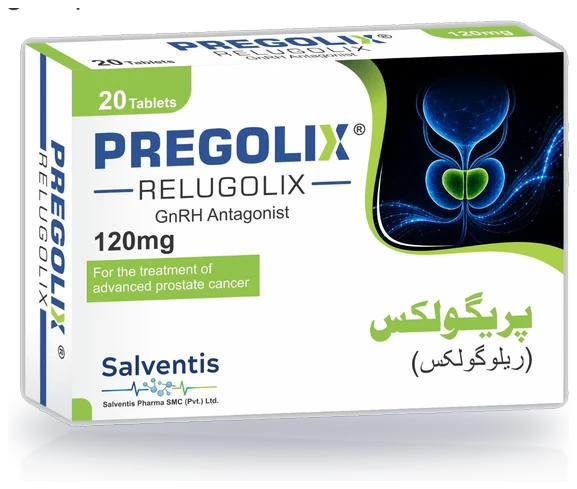
Pregolix® contains Relugolix, a gonadotropin-releasing hormone (GnRH) receptor antagonist indicated for the treatment of advanced prostate cancer.
Rapid suppression of testosterone to castrate levels.
No initial testosterone surge or clinical flare.
Sustained testosterone suppression with once-daily oral dosing.
Oral administration without the need for injections.
Key clinical effects as listed in the Pregolix® package leaflet.
Relugolix is a nonpeptide gonadotropin-releasing hormone (GnRH) receptor antagonist that competitively binds to pituitary GnRH receptors, thereby reducing the release of luteinizing hormone (LH) and follicle-stimulating hormone (FSH), and consequently testosterone. In men, this results in rapid and sustained suppression of testosterone to castrate levels without an initial testosterone surge.
Source: Pregolix® 120 mg package leaflet.
Pregolix® (Relugolix) is indicated for the treatment of adult patients with advanced prostate cancer.
For the treatment of advanced hormone-sensitive prostate cancer, as specified in the approved prescribing information.
The recommended adult dose is a loading dose of 360 mg (three 120 mg tablets of Pregolix®) on the first day of treatment, followed by 120 mg (one tablet) taken orally once daily at approximately the same time each day.
Mean (± SD) exposure to Relugolix, as stated in the package leaflet:
| Dosing | AUC (ng·hr/mL) | Cmax (ng/mL) |
|---|---|---|
| Single 360 mg loading dose | 985 (± 742) | 215 (± 184) |
| 120 mg once daily, steady state | 407 (± 168) | 70 (± 65) |
After oral administration, Relugolix is rapidly absorbed. The absolute bioavailability is approximately 12%. Peak plasma concentrations are reached at a median Tmax of approximately 2.25 hours (range 0.5–5 hours). Food has no clinically meaningful effect on the pharmacokinetics of Relugolix.
The plasma protein binding of Relugolix is 68%–71%, mainly to albumin and to a lesser extent to α1-acid glycoprotein. Relugolix is widely distributed to tissues.
Relugolix is primarily metabolized by CYP3A and to a lesser extent by CYP2C8 in vitro. No major metabolites account for more than 10% of total drug-related material in plasma.
Following oral administration of radiolabeled Relugolix, approximately 81% of the dose was recovered in feces (4.2% as unchanged drug) and 4.1% in urine (2.2% as unchanged drug). The mean effective half-life is approximately 25 hours, and the mean terminal elimination half-life is approximately 61 hours. Steady state is achieved within approximately 2 weeks of once-daily dosing.
The most common adverse reactions (≥10%) and laboratory abnormalities (≥15%) include: hot flush, glucose increased, triglycerides increased, musculoskeletal pain, hemoglobin decreased, alanine aminotransferase (ALT) increased, fatigue, aspartate aminotransferase (AST) increased, constipation, and diarrhea.
Other reported adverse reactions may include: weight increase, hypertension, hyperhidrosis, rash, nausea, decreased libido, erectile dysfunction, gynecomastia, insomnia, and depression.
P-gp inhibitors: Concomitant use of Pregolix® with oral P-glycoprotein (P-gp) inhibitors may increase Relugolix exposure. Avoid co-administration with oral P-gp inhibitors. If unavoidable, take Pregolix® first and separate dosing by at least 6 hours.
Combined P-gp and strong CYP3A inducers: Concomitant use of Pregolix® with combined P-gp and strong CYP3A inducers may decrease Relugolix exposure. Avoid co-administration. If unavoidable, increase the Pregolix® dose to 240 mg once daily.
Other considerations: Androgen deprivation therapy may prolong the QT interval; use caution with drugs known to prolong the QT/QTc interval.
Based on findings in animals and mechanism of action, Relugolix can cause fetal harm and loss of pregnancy when administered to a pregnant woman. There are no data on the presence of Relugolix or its metabolites in human milk, the effects on the breastfed child, or milk production. Advise women not to breastfeed during treatment with Pregolix® and for 2 weeks after the final dose.
In the event of overdose, appropriate supportive treatment should be instituted according to the patient's clinical signs and symptoms. There is no specific antidote for Relugolix.
Do not store above 30°C in a dry place. Protect from sunlight, heat and moisture. The expiration date refers to the product correctly stored at the required conditions.
Source: Pregolix® 120 mg package leaflet. Read the full leaflet online.
| Brand | Pregolix® |
|---|---|
| Generic | Relugolix |
| Strength | 120 mg per film-coated tablet |
| Dosage form | Film-coated tablet, oral |
| Pack | Blister pack of 20 tablets |
| Therapeutic area | Oncology · urology |
| Prescription status | Prescription-only medicine |
| DRAP registration no. | 129908 |
| Manufacturing licence no. | 000971 |
| Manufactured by | Skywin Pharmaceuticals (Pvt.) Ltd., Sheikhupura Road |
| Manufactured for | Wimits Pharmaceuticals (Pvt.) Ltd., Lahore |
| Marketed by | Salventis Pharma SMC (Pvt.) Ltd., Islamabad |
| Storage | Do not store above 30°C in a dry place; protect from sunlight, heat and moisture |